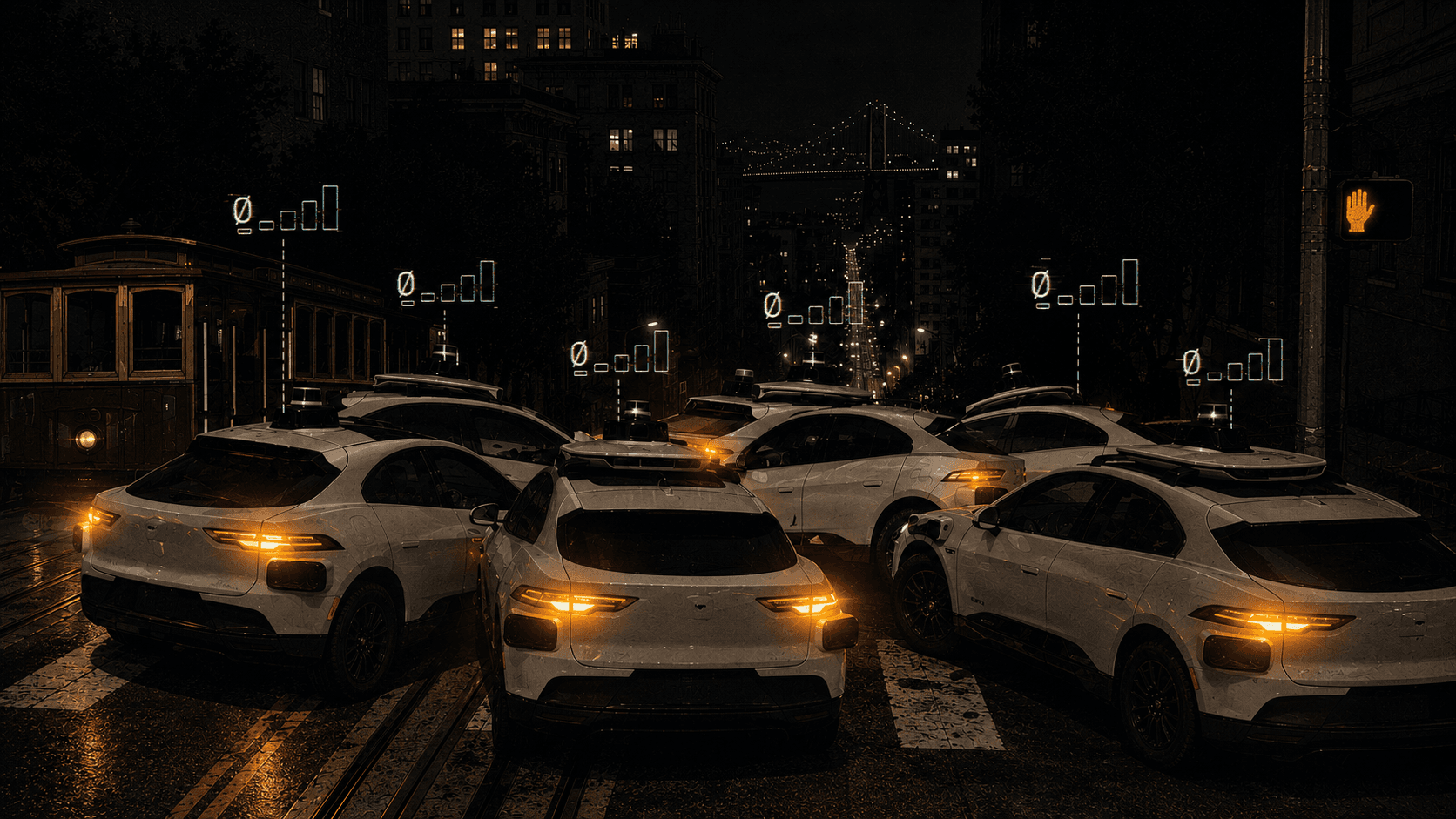
A swarm of driverless robotaxis bricks itself simultaneously in an intersection, leaving San Francisco drivers trapped in a mechanical standoff.
For the past couple of years, tech companies have promised that autonomous vehicles will optimize our infrastructure, eliminate human error, and usher in a peaceful era of seamless urban transit. Instead, they have turned San Francisco into a live-action beta testing ground where the local emergency services are routinely forced to negotiate with empty vehicles that refuse to get out of the way.
The structural absurdity hit a magnificent peak in the city's North Beach neighborhood. Just a day after state regulators officially voted to grant major driverless companies permission to expand to unrestricted, 24/7 paid service, a fleet of up to a dozen Cruise robotaxis migrated toward the same intersection and collectively shut down. Hazard lights blinking in perfect, unblinking unison, the vehicles formed a multi-car brick wall that completely gridlocked several city blocks for nearly twenty minutes while human drivers stood on their horns in absolute futility.
The corporate post-mortem was a beautiful example of automated fragility. The company officially blamed the mass paralysis on "wireless bandwidth constraints" caused by the nearby Outside Lands music festival. Because thousands of teenagers were simultaneously trying to upload videos to TikTok, the local cell towers became overloaded. Deprived of their continuous data feed from corporate headquarters, the multimillion-dollar artificial intelligence units did what any panicked student driver would do: they froze in terror in the middle of a busy street, entirely unable to figure out how to drive straight without a cellular connection.
Local officials and emergency workers have been furious. The San Francisco Fire Department has recorded dozens of incidents where confused, driverless cars have blocked fire trucks, driven over active fire hoses, or gotten physically entangled in downed power wires. While human drivers have resorted to placing orange construction cones on the hoods of the cars to trick their cameras into shutting down entirely, tech executives maintain that these mass standoffs are just temporary bumps on the road to a driverless future.
Read the rest at CNN Business →